The death of the king of Thailand throws the country into turmoil,,,a mourning period of one year was declared.
THAILAND’S constitutional monarch, Bhumibol Adulyadej, spent much of the past seven years living in an infirmary in the royal heart of the capital, Bangkok. During that time the palace pumped out nearly 40 updates about the 88-year-old sovereign’s treatment—but normally only after each health scare had passed. So when authorities announced on October 9th that the king’s condition was “not stable”, his subjects knew what was coming. By the evening of October 12th a large crowd of well-wishers had gathered to pray in the central courtyard of Siriraj hospital; many came dressed in yellow and pink, two auspicious hues. The next day they were told that the world’s longest-reigning monarch had died.
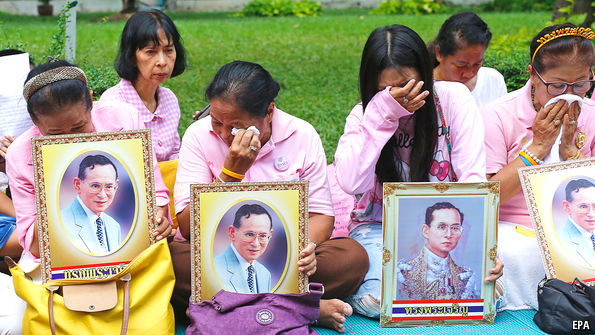
King Bhumibol’s passing is an important moment for many Thais, most of whom have known no other monarch. The staunchest royalists revere the monarch with a quasi-religious fervour. The king’s portrait is displayed outside public buildings, and at the entrance to myriad villages. Millions of homes, and almost all hotel rooms, contain a picture of him too.
The mourning afterIn a statement read on television Prayuth Chan-Ocha, the junta leader, declared a mourning period of one year, during which time civil servants will be expected to wear sombre clothes. He asked the public to refrain from any celebrations for a month, which could mean some entertainment venues may be closed. Many businesses will hope to avoid lengthy enforced shutdowns (jitters over the succession have already bitten a chunk out of the stockmarket, which fell by 8% over the four trading sessions to October 13th). Some multinationals and international organisations have been preparing in case their staff must spend the next few weeks working from home.


Comments